
Watch the Documentary — 5 Minutes With Art
Why did Francisco Goya paint this terrifying image on the walls of his own home?
Discover the mythology, mysteries and extraordinary history behind Saturn Devouring His Son in our five-minute art-history documentary.
An ancient myth, a house filled with disturbing images, and a remarkable photograph that reveals how one of art history's most unsettling paintings has changed over time.
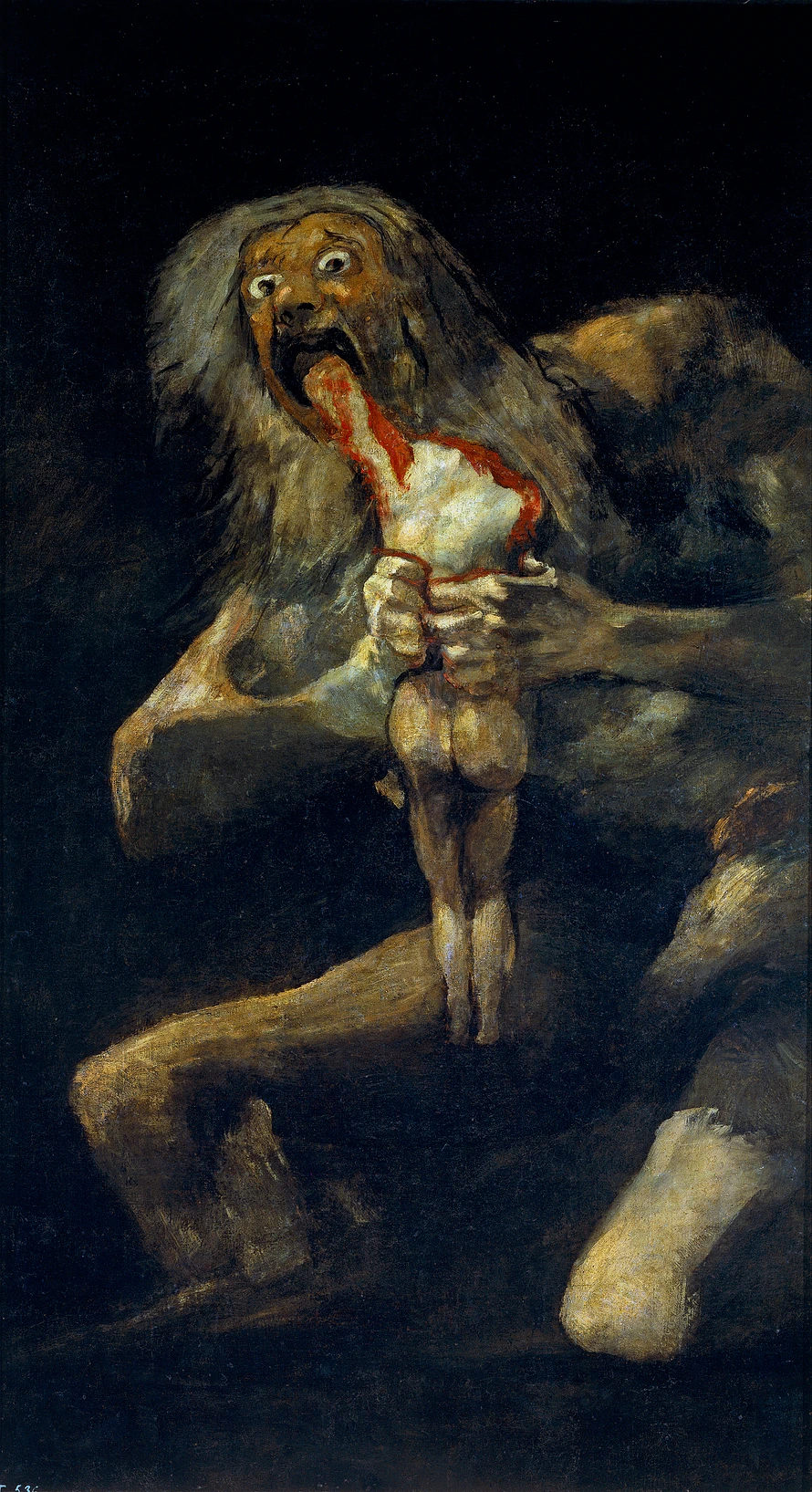
There is something almost impossible to forget about Francisco Goya's Saturn Devouring His Son.
A wild-eyed figure emerges from darkness, clutching a mutilated body in his hands. His mouth is open, his expression caught somewhere between terror and desperate hunger. There is no reassuring landscape, no recognisable setting, and nothing to distance us from the violence.
Yet perhaps the most extraordinary fact about this painting is not what it depicts.
Goya originally painted it directly onto a wall inside his own home.
Created around 1820–1823, Saturn Devouring His Son belonged to a mysterious group of works now known as the Black Paintings. They were not conventional public commissions, and more than two centuries later, we are still debating what Goya intended them to express.
And the painting we see today is not quite the one that originally appeared on his wall.
The Myth of Saturn: A Father Terrified of His Children
The painting draws upon one of the most disturbing stories in classical mythology.
In Greek tradition, the Titan Cronus was warned that one of his children would eventually overthrow him, just as he had overthrown his own father.
Determined to prevent this fate, Cronus swallowed his children as soon as they were born.
His wife Rhea eventually deceived him, hiding their youngest son, Zeus, and presenting Cronus with a stone wrapped in cloth instead. Zeus survived, grew to adulthood, and ultimately defeated his father.
The Roman Saturn became closely identified with Cronus, and the story provided artists with a powerful image of fear, tyranny and destructive power.
At its heart lies a terrible paradox: in attempting to preserve his authority, Saturn destroys the very children who might have inherited it.
The myth could be understood as a warning about rulers consumed by fear, or more broadly as an image of time swallowing everything it creates.
But Goya was far from the first artist to depict it.
Two Visions of Saturn: Rubens and Goya
Almost two centuries earlier, Peter Paul Rubens had painted his own Saturn Devouring a Son (1636–1638), now also held by the Museo del Prado in Madrid.
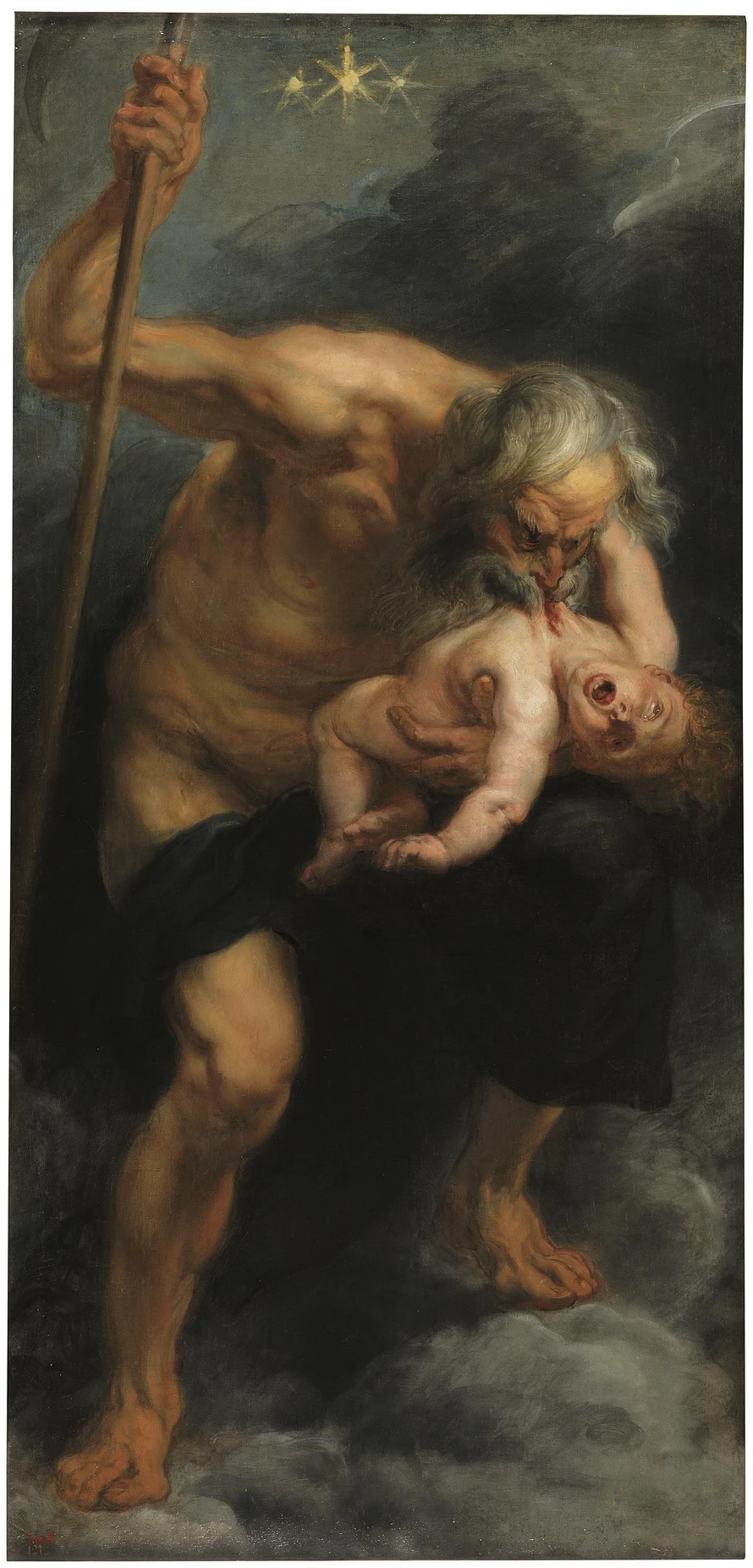
Rubens presents Saturn as a powerful elderly figure, gripping his traditional scythe while attacking a struggling child. The scene is unmistakably violent, yet its classical attributes identify the god and connect the horror to a familiar mythological tradition.
Goya strips much of that visual language away.
His Saturn possesses no obvious scythe, throne or divine setting. The figure emerges from an almost featureless darkness, with dishevelled hair, staring eyes and a body rendered in forceful, expressive brushstrokes.
The victim, meanwhile, bears little resemblance to the helpless infant conventionally associated with the story.
Rather than carefully narrating the myth, Goya seems to confront us with its emotional extremity.
Rubens shows us a terrible act committed by a mythological god. Goya's interpretation feels less distant — a scene of uncontrollable violence in which even the aggressor appears consumed by terror.
The contrast raises an important question.
Why did Goya choose to interpret this myth in such a disturbing way?
The Quinta del Sordo: A House Outside Madrid
In 1819, Goya purchased a country property beside the River Manzanares, on the outskirts of Madrid.
It was known as the Quinta del Sordo — usually translated as the House of the Deaf Man.
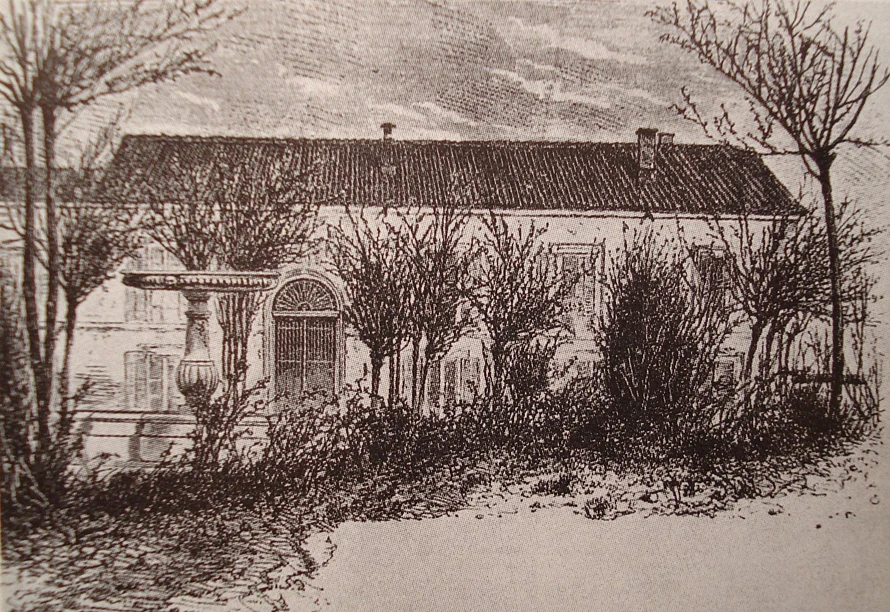
The name is particularly striking because Goya himself had been profoundly deaf since an illness in the 1790s. However, the property already carried this name before he acquired it.
By this stage, Goya was in his seventies and had lived through extraordinary upheaval.
He had witnessed the Napoleonic invasion of Spain, the brutal Peninsular War and the political turmoil that followed. His art had already explored human cruelty with extraordinary directness, notably in The Third of May 1808 and his Disasters of War prints.
Then, in late 1819, Goya became seriously ill.
He survived with the assistance of his physician, Eugenio García Arrieta, and subsequently commemorated his recovery in the deeply personal Self-Portrait with Dr. Arrieta (1820).
These experiences provide important context for his later work. Yet we should be cautious about treating them as a complete explanation.
There is no surviving statement from Goya declaring that illness, despair or political disillusionment drove him to create the Black Paintings.
What we do know is that, during his remaining years at the Quinta del Sordo, he transformed parts of his home into something extraordinary.
Fourteen Black Paintings — and No Certain Explanation
Across two rooms on different floors, Goya painted a series of strange, often deeply unsettling images directly onto the walls of his house.
Fourteen of these works survive today.
Their familiar collective name, the Black Paintings, reflects both their predominantly dark colours and their sombre, frequently disturbing subject matter.
Among them are Witches' Sabbath (The Great He-Goat), an eerie gathering dominated by a dark goat-like figure; Two Old Men Eating, in which an ordinary activity becomes grotesque; and The Dog, an extraordinarily sparse image of a small dog's head beneath a vast expanse of empty colour.
These paintings do not all depict the same kind of horror.
Some suggest supernatural rituals or unexplained gatherings. Others portray conflict, ageing or human figures whose intentions remain obscure. In The Dog, almost all recognisable narrative has disappeared.
The remarkable thing is that these were not paintings prepared for a public exhibition. They formed part of Goya's domestic surroundings.
We do not know precisely who viewed them during his lifetime, nor whether he intended them to convey a unified message.
Even the familiar titles were not securely recorded by Goya himself.
The exact original arrangement of the paintings has also been debated, despite later inventories and historical photographs that help reconstruct their setting.
What remains is a collection that seems unusually private, experimental and resistant to simple interpretation.
What Does Saturn Devouring His Son Really Mean?
Few paintings invite psychological interpretation as powerfully as Saturn.
One reading sees it as an image of political tyranny: power so terrified of its own replacement that it destroys the next generation.
Considering the upheaval Goya witnessed in Spain, the interpretation is certainly compelling.
Another approach emphasises mortality and the passage of time.
Saturn was associated with time, ageing and melancholy in European artistic and intellectual traditions. Seen in this light, the figure's desperate hunger might symbolise time consuming everything — including life, youth and power.
Art historians have also explored possible connections between the Black Paintings and Goya's own experiences of illness and old age.
Yet none of these explanations can be established as his definitive intention.
There is another possibility worth considering: perhaps the painting is disturbing precisely because it cannot be reduced to a single meaning.
Saturn appears simultaneously monstrous and terrified. His victim is helpless, but the god himself seems almost overwhelmed by the act he is committing.
Is this a painting about absolute power, or about the fear that makes power destructive?
Is it an expression of personal anxiety, a political metaphor, or a meditation on humanity's capacity for violence?
We cannot know with certainty.
And remarkably, the mystery extends beyond the painting's meaning to its physical appearance.
Before the Painting Left the Wall: Jean Laurent's Photograph
Today, Saturn Devouring His Son appears as a freestanding canvas in the Museo del Prado.
But it did not begin that way.
In the nineteenth century, photographer Jean Laurent documented the Black Paintings while they were still attached to the walls of the Quinta del Sordo.
Among the surviving images is a remarkable photograph of Saturn, generally dated to the 1870s.
The photograph shows the painting surrounded by decorative borders, giving us a glimpse of its original domestic presentation. It also records a surface already marked by age and deterioration.
This is important because the Black Paintings were subsequently subjected to a difficult process of removal.
The Quinta del Sordo changed ownership several times after Goya's departure. In 1873, the property was acquired by Baron Frédéric Émile d'Erlanger, who commissioned the transfer of the murals onto canvas.
The work was undertaken by Salvador Martínez Cubells, a restorer associated with the Prado.
It preserved the paintings from their eventual loss with the house — but at a considerable cost.
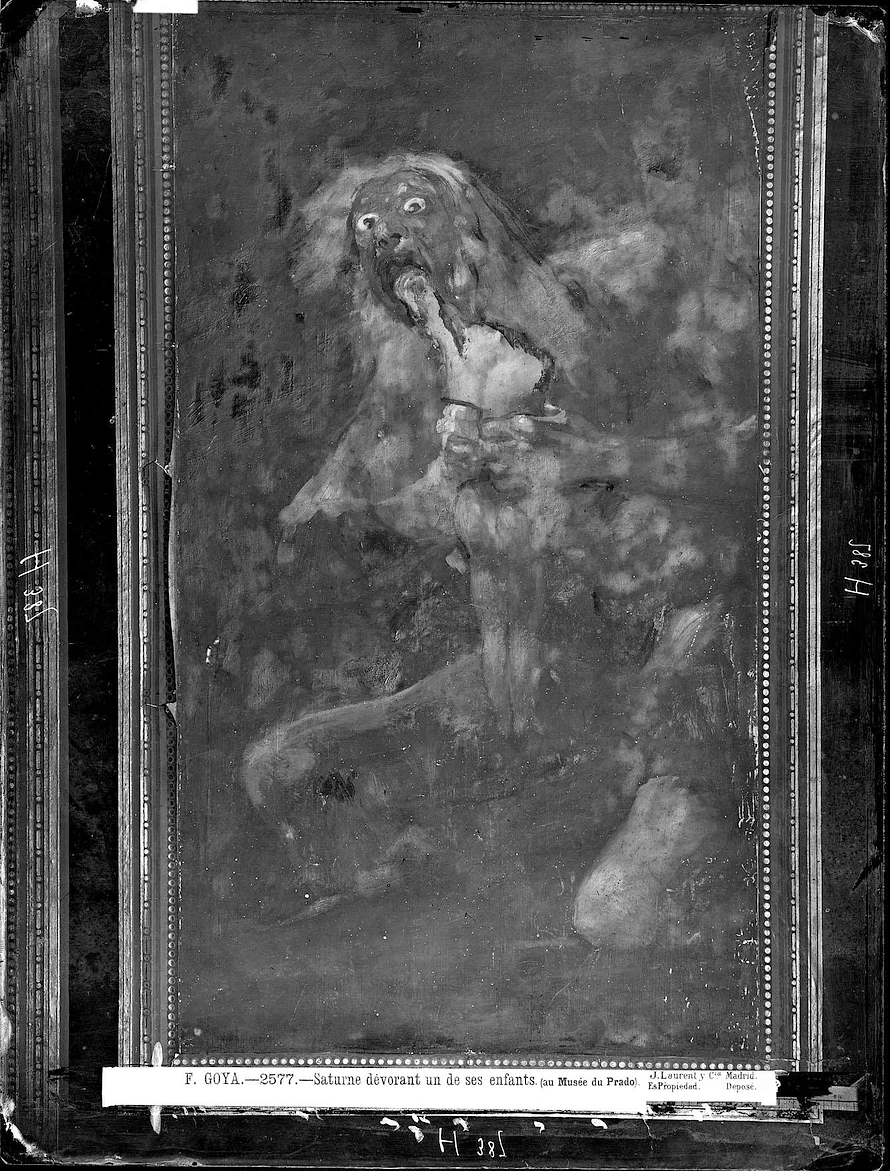
Jean Laurent, Saturn at the Quinta del Sordo, c. 1874. Historical photograph before the mural's transfer to canvas.
The Restoration That Changed Saturn's Face
Removing large paintings from plaster walls is a difficult and potentially destructive process.
The Black Paintings suffered substantial paint loss during their transfer, and restoration became necessary to make them presentable.
Some portions of the surviving works are therefore the result not only of Goya's original painting, but also of later intervention.
One particularly fascinating detail concerns Saturn's famous eyes.
According to Fundación Goya en Aragón, the eyes were among the areas seriously damaged and subsequently repainted during an early restoration of the transferred mural.
This raises a remarkable possibility.
The terrifying gaze that has become one of the most recognisable features of Goya's Saturn may not be identical in every detail to the expression he originally created.
Laurent's historical photograph provides an invaluable point of comparison.
Of course, differences between a nineteenth-century monochrome photograph and a modern colour reproduction cannot all be attributed to restoration. Photography, lighting, ageing and conservation history complicate any direct comparison.
Nevertheless, the surviving evidence reminds us that paintings are physical objects with histories of their own.
What we encounter in a museum is not always an entirely unchanged record of the artist's final brushstroke.
The Black Paintings were exhibited in Paris in 1878. In 1881, d'Erlanger donated them to the Spanish state, and they became part of the Museo del Prado's collection.
The Quinta del Sordo itself was demolished in the early twentieth century.
Without the transfer, the paintings might not have survived at all.
Why Goya's Saturn Still Disturbs Us
More than two hundred years after its creation, Saturn Devouring His Son remains one of the most unforgettable images in Western art.
Its violent subject is only part of the reason.
Goya abandoned much of the visual reassurance that traditionally accompanied mythological painting. There is no grand setting to provide distance from the scene, no obvious moral resolution, and no comforting sense that the horror belongs safely to another world.
Instead, we confront an image of desperate, destructive fear.
Its vigorous brushwork and distorted expression would later be admired for qualities associated with modern Expressionism, anticipating the emotional intensity of artists such as Francis Bacon.
Yet the work continues to resist explanation.
We know the ancient myth. We know the house in which Goya painted it. We can study the political and personal circumstances of his later life, and even examine photographs showing the mural before its removal.
But we cannot definitively answer the simplest question of all.
Why did Goya choose to live with this image on the walls of his own home?
Perhaps that uncertainty is part of its lasting power.
Every generation approaches Saturn with its own anxieties — about ageing, violence, power, mortality and the fear of losing control.
And every viewer brings something different to those staring eyes.
What do you see in Goya's Saturn?
Explore More of Francisco Goya
Discover more of Goya's extraordinary artistic world in our Francisco Goya biography, explore his haunting painting The Dog, or browse the Between Forms collection inspired by his remarkable works.