
Why does a solitary knight ride calmly through a landscape haunted by Death and the Devil?
In 1513, the German Renaissance artist Albrecht Dürer created one of the most remarkable and mysterious engravings in the history of European art.
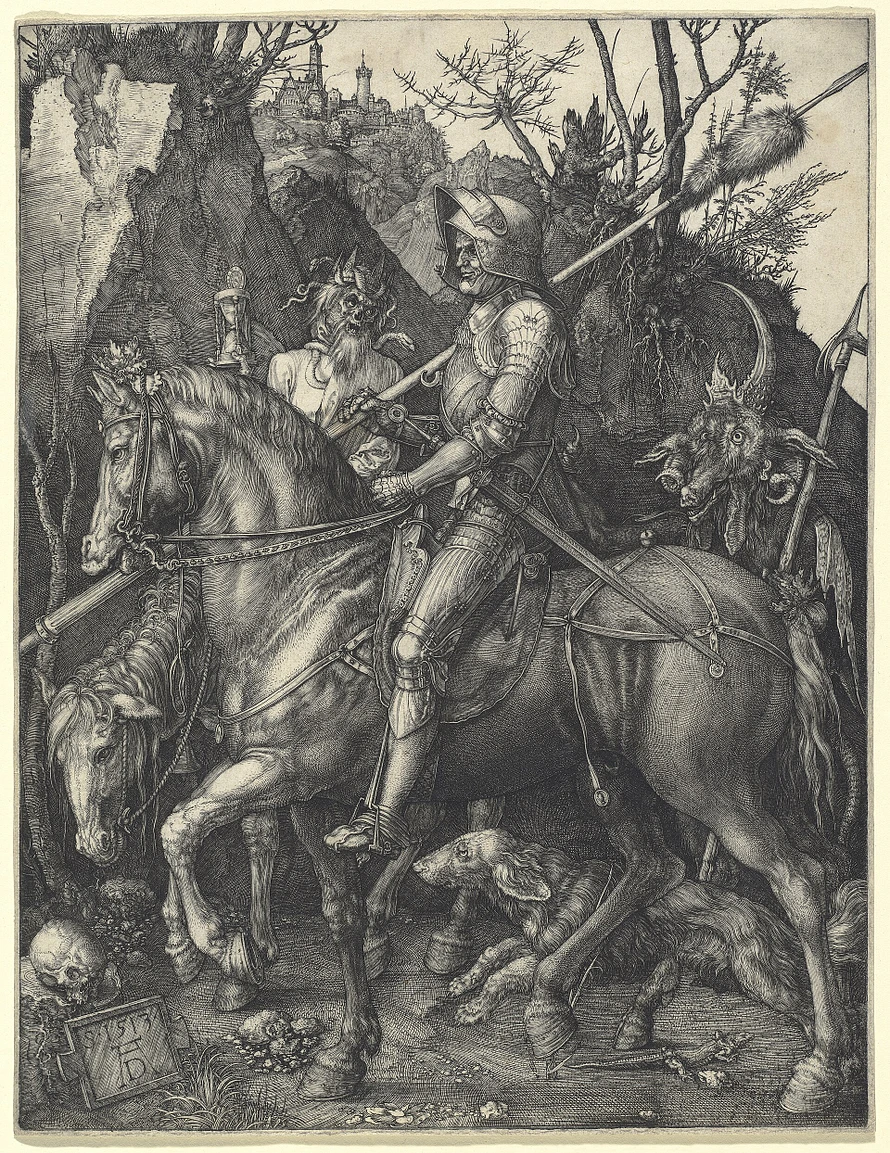
A heavily armoured knight rides along a narrow, rocky path. Beside him, a decaying figure holds up an hourglass. Behind him lurks a grotesque creature, part animal and part nightmare.
Yet the knight does not turn to confront them. His sword remains sheathed. His gaze is fixed on the road ahead.
Is he courageous? Faithful? Reckless? Or does the engraving conceal something darker?
More than five centuries later, Knight, Death and the Devil continues to invite questions about mortality, temptation and what it means to persevere in the face of uncertainty.
A Journey Through a Threatening World
At the centre of Dürer's composition, the knight rides a powerful horse through a narrow passage enclosed by jagged rocks and twisted trees.
His armour gleams despite the absence of colour. His posture is upright and controlled, his expression seemingly indifferent to the dangers surrounding him.
Beside him rides Death, depicted not as a distant abstraction but as a decaying, almost human presence. Serpents coil around his grotesque form, while his exhausted horse provides a striking contrast to the knight's magnificent mount.
Death holds an hourglass towards the rider.
Its meaning is difficult to ignore. Time is passing. Life is finite. No amount of strength, status or armour can prevent its eventual end.
Behind the knight follows the Devil, a bizarre creature assembled from animal-like features. Its bulging eyes, horns and elongated snout are simultaneously absurd and disturbing. It carries a weapon, yet makes no move to attack.
The knight neither fights nor flees.
He simply continues forward.
That apparent indifference is one of the engraving's greatest mysteries.
The Hidden Symbolism of Dürer's Engraving
Almost every corner of Knight, Death and the Devil contains something worth examining.
The hourglass is the clearest symbol: a reminder of mortality and the relentless passing of time. It belongs to the tradition of memento mori — the encouragement to remember that life is temporary.
The skull, resting near Dürer's signature tablet in the lower-left corner, reinforces this warning. Death is not merely following the knight; its presence is woven into the landscape itself.
The dog, running beneath the knight's horse, is often interpreted as a symbol of loyalty or faithfulness. It accompanies the rider through the dangerous terrain, suggesting steadfastness in the midst of uncertainty.
The tiny lizard, almost lost among the engraved lines near the horses' feet, darts in the opposite direction. Its precise symbolic meaning is uncertain, but it adds another unsettling detail to a landscape already filled with danger.
The distant castle, perched high above the rocky passage, introduces an intriguing contrast. Could it represent safety, spiritual refuge or the promise of salvation? Perhaps. But Dürer offers no clear explanation, and the knight's destination remains unknown.
Together, these details transform what might initially appear to be a medieval adventure into something more philosophical: a journey through a world in which danger, temptation and death are unavoidable companions.
The Christian Knight: Courage and Faith
The most familiar interpretation sees the rider as an embodiment of Christian virtue.
This reading has often been associated with the Renaissance humanist Desiderius Erasmus and his influential Handbook of the Christian Soldier, first published in the early sixteenth century.
Erasmus described the Christian life as a difficult journey requiring moral courage and perseverance. Temptation and adversity were not reasons to abandon the path, but challenges through which faith must endure.
Dürer's knight appears to embody something similar.
He is surrounded by threatening figures, yet remains focused on the road ahead. His armour and weapons seem less important than his determination not to be distracted.
The engraving can therefore be understood as an image of moral steadfastness: a person continuing along a difficult path despite the dangers surrounding him.
It is a compelling interpretation, although we cannot establish with certainty that Erasmus's writing directly inspired Dürer.
And there is another possibility.
What If the Knight Is Not a Hero?
Some scholars have proposed a considerably darker reading.
Rather than representing a virtuous Christian soldier, the figure might be a Raubritter — a robber knight, one of the armed nobles who preyed upon travellers and merchants in parts of the Holy Roman Empire.
From this perspective, the knight's indifference to Death and the Devil takes on a troubling meaning.
Perhaps he is not resisting evil at all.
Perhaps he belongs in its company.
Supporters of this interpretation have drawn attention to the fox's tail attached to the knight's lance, suggesting an association with cunning or deceit. However, such an ornament need not have carried a sinister meaning, and its presence cannot establish the rider's identity.
The darker interpretation remains disputed.
What makes the uncertainty especially fascinating is that Dürer himself referred to the engraving simply as Reuter — “the Rider” — in his Netherlands travel diary.
He did not leave us a definitive explanation of the elaborate symbolism that later generations have found in the image.
The knight's expression may appear resolute, but his true purpose remains open to interpretation.
An Extraordinary Achievement in Engraving
Whatever its intended meaning, Knight, Death and the Devil is an astonishing demonstration of Dürer's technical mastery.
The original engraving measures only approximately 25 × 19 centimetres — not much larger than a paperback book.
Yet within that modest space, Dürer created an extraordinary world of light, texture, movement and three-dimensional form.
Unlike a painter applying tones with a brush, an engraver works by cutting lines into a metal plate.
Using a sharp steel tool called a burin, Dürer incised intricate grooves into copper. Ink was worked into these grooves, the plate's surface was wiped, and the image was transferred to paper under pressure.
The resulting print is built from countless carefully controlled marks.
Look closely at the knight's armour. Delicate lines suggest polished metal, curved surfaces and reflected light. The overlapping plates appear solid and convincing.
Now examine the horse. Its muscles, mane and powerful body are rendered with an entirely different quality of line, suggesting organic movement rather than rigid steel.
Even the bark of the trees, the rocky ground and the monstrous features of Death and the Devil possess their own distinct textures.
Dürer's understanding of armour was grounded partly in careful observation. A surviving drawing from 1498 records the type of armour worn in Germany at the time, and elements of that earlier study informed the later engraving.
Knight, Death and the Devil is one of three celebrated works known as Dürer's Meisterstiche, or master engravings, alongside Melencolia I (1514) and Saint Jerome in His Study (1514).
Although often discussed together, they were not necessarily conceived as a formal trilogy.
Each nevertheless demonstrates an extraordinary union of artistic imagination, intellectual complexity and technical skill.
Why the Knight's Journey Still Matters
It would be easy to admire Dürer's engraving simply as a masterpiece of Renaissance printmaking.
But perhaps its lasting power lies somewhere more personal.
We cannot escape the passing of time.
Illness, loss, ageing, disappointment and uncertainty eventually touch every life. Some fears arise suddenly and disappear. Others remain with us for years, becoming part of the landscape through which we must find our way.
There are times when life resembles Dürer's narrow, difficult path more than any open road.
And perhaps that is why the knight can feel so compelling.
His surroundings are threatening. Death has not vanished. The Devil has not been defeated. Whatever awaits him beyond the rocks remains uncertain.
Yet he continues.
We need not assume that Dürer intended a modern message about emotional resilience. Nor must we settle the centuries-old argument about whether his knight is heroic or morally compromised.
The image can hold historical uncertainty while still allowing a deeply personal response.
For some viewers, the knight may represent faith. For others, courage, determination or the difficult act of carrying on when there are no reassuring answers.
Perhaps perseverance is not always about overcoming every obstacle.
Sometimes it is simply about continuing to live while those obstacles remain.
Five centuries after Dürer engraved his solitary traveller, that possibility still has the power to move us.
The darkness is still there.
And yet the journey continues.
Watch: Knight, Death and the Devil — 5 Minutes With Art
Explore the engraving's symbolism, competing interpretations and extraordinary craftsmanship in our short documentary from 5 Minutes With Art.
Watch Why Is He Unafraid? — Dürer's Knight, Death and the Devil (1513)
Bring a piece of art history into everyday life. Explore our Albrecht Dürer collection, featuring this remarkable Renaissance engraving.