
Few paintings seem to announce their subject more clearly than Sandro Botticelli’s The Birth of Venus.
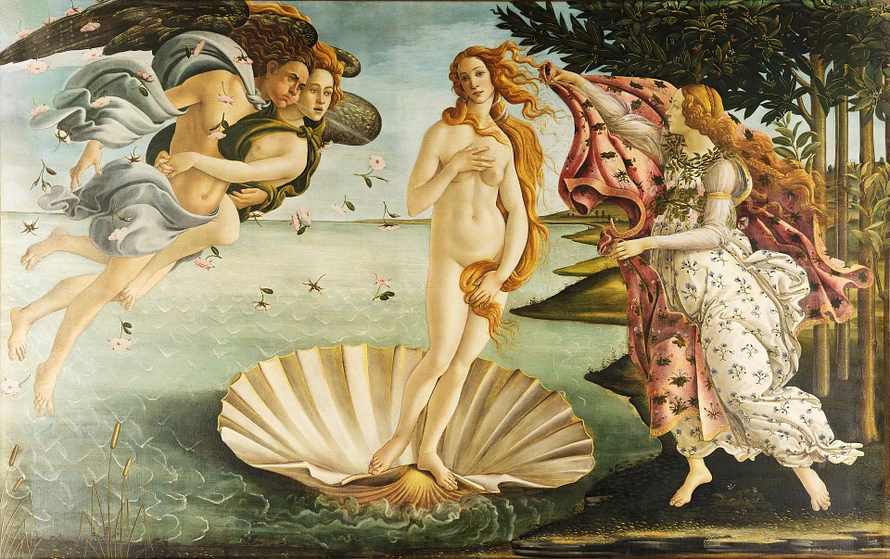
A nude goddess stands on an enormous shell. Winds carry her across the sea. Roses scatter through the air while a richly dressed figure waits on shore with a flower-covered cloak.
It appears to be the birth of Venus.
Except it isn’t.
Botticelli does not actually show the goddess being born. By the time we see her, Venus is already fully grown and travelling across the water. The scene is better understood as her arrival on land, traditionally identified as the island of Cyprus. Even the Uffizi Gallery, where the painting now hangs, points out that its familiar title is slightly misleading. Gallerie degli Uffizi
That is only the first of several things about one of the Renaissance’s most famous paintings that become more interesting the closer we look.
Botticelli and a New Kind of Renaissance Painting
Sandro Botticelli was born in Florence around 1445 and trained under Fra Filippo Lippi before establishing his own workshop. By the 1470s and 1480s he was working within the cultural world surrounding Florence’s most powerful families, including the Medici circle, and in 1481 his reputation was strong enough for him to be summoned to Rome to help decorate the walls of the Sistine Chapel. National Gallery
The Birth of Venus was probably painted around 1485.
It is enormous: approximately 172.5 by 278.5 centimetres, or more than nine feet across. And unlike many prestigious Florentine paintings of the period, it was painted in tempera on canvas rather than wooden panel. The Uffizi notes that canvas was often used for decorative paintings intended for noble residences. Gallerie degli Uffizi
That domestic context matters because The Birth of Venus was an unusual image.
A monumental, almost life-size female nude drawn from pagan mythology was hardly an everyday subject in fifteenth-century Florence. Smarthistory describes the full-length female nude as particularly unusual for the period. Smart History
Centuries of Christian art had not erased knowledge of classical mythology, but Botticelli gives Venus a scale, dignity and prominence that announce just how energetically Renaissance Florence was rediscovering the ancient world.
The Birth That Botticelli Does Not Show
According to classical mythology, Venus — Aphrodite to the Greeks — was born from the sea.
Botticelli skips the strange and violent details surrounding that birth and presents something far more lyrical.
Venus has already emerged.
She stands upright on a huge scallop shell while the wind carries her towards the shore. On the left, a winged male figure is securely identified as Zephyrus, the west wind. The identity of the woman entwined with him is less certain. She is frequently called Chloris, but the Uffizi more cautiously suggests that she may be Aura, another personification of breeze or air. Gallerie degli Uffizi
That uncertainty is worth preserving. Famous paintings tend to acquire labels that eventually sound like facts even when the evidence is less definite.
On the opposite shore, another woman reaches towards Venus with a magnificent flowered cloak. She is commonly identified as one of the Horae, goddesses associated with the seasons — specifically the Hora of Spring — although the Uffizi notes that she has also been interpreted as one of the Graces. Gallerie degli Uffizi
Everything pushes towards arrival.
The winds blow from left to right. Venus’s hair streams with them. Roses scatter through the air. The figure on shore steps forward to receive her.
Botticelli has turned mythology into a carefully choreographed entrance.
A Painting Made of Movement
One of the reasons The Birth of Venus feels so different from many Renaissance paintings is that Botticelli is less interested in making the scene look physically convincing than in making it flow.
Venus does not stand with the solid weight of a classical marble statue.
She seems almost weightless.
Her neck is elongated. Her shoulders slope unusually. Her body bends in a long, elegant curve rather than standing firmly over its centre of gravity. The shell beneath her hardly seems like something capable of carrying a human body across a real sea.
And that is precisely why the painting works.
Botticelli’s great strength here is line.
The curves of Venus’s body continue into the sweep of her hair. The winds’ clothing billows around them. The pink cloak on the right curls back on itself. Trees bend, flowers fly and waves repeat in delicate patterns.
The entire picture feels as if it has been caught by the same breeze.
Rather than correcting these physical improbabilities, Botticelli uses them to make Venus seem as though she belongs to a different order of existence.
She is not simply a woman standing on a shell.
She is an apparition.
Why Venus Covers Herself
Venus’s pose also reaches backwards into antiquity.
She attempts to cover her body with one hand while her long hair falls across her lower body. The Uffizi connects this modest gesture directly to classical statues of Venus. Gallerie degli Uffizi
The pose belongs to a tradition often called the Venus Pudica, or “modest Venus”: an image in which the goddess simultaneously reveals and conceals her nudity.
That contradiction is central to the effect.
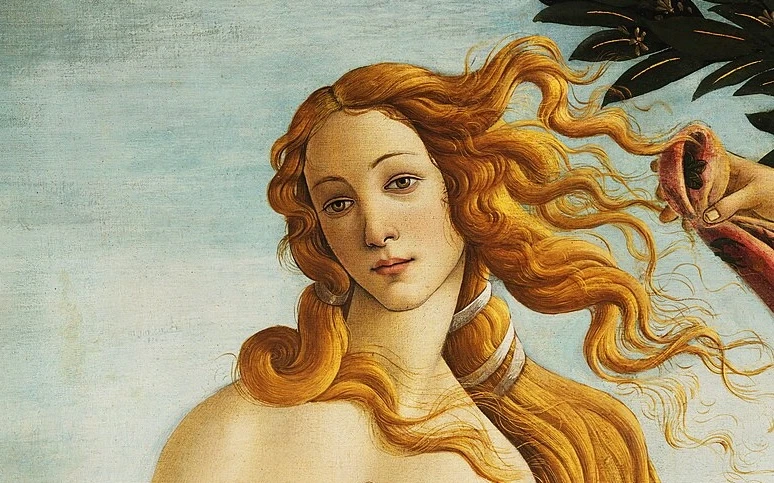
Venus is completely exposed and yet strangely remote. Her nudity is not presented with the physical realism Botticelli might have used for an ordinary mortal. Her pale body, impossibly long hair and distant expression make her feel less erotic in a straightforward sense than idealised and unattainable.
Even the hair contains a luxurious detail easily lost in reproduction: Botticelli used gold to create some of its luminous highlights. Gallerie degli Uffizi
The result is not naturalism.
It is an idea of beauty made visible.
Where Did Botticelli Get the Story?
Classical literature offered several accounts of Aphrodite’s birth and arrival.
But one especially important Renaissance connection leads to Agnolo Poliziano, the Florentine poet associated with the intellectual world of Lorenzo de’ Medici.
Poliziano’s Stanze per la Giostra includes a richly visual description of Venus and draws upon ancient Greek poetry, including the Homeric Hymns to Aphrodite. Modern scholarship has explored closely how Poliziano reworked those ancient sources. OUP Academic
The Uffizi consequently suggests that Poliziano may have helped inspire Botticelli’s subject. Gallerie degli Uffizi
But again, “may have” matters.
We do not possess Botticelli’s preparatory explanation telling us exactly which text he followed.
What we can see is a remarkable Renaissance chain of rediscovery: ancient poetry inspires a fifteenth-century Florentine poet, classical sculpture informs Botticelli’s Venus, and ancient imagery is transformed into something unmistakably new.
Even the embracing Winds may have had an antique visual source. The Uffizi links them to a Hellenistic gem owned by Lorenzo de’ Medici. Gallerie degli Uffizi
Was the Painting Made for the Medici?
The Medici connection is very plausible — but less certain than it is often presented.
There is no surviving commission for The Birth of Venus, and we do not know with certainty who first ordered it or precisely where it originally hung.
The earliest firm documentary evidence comes much later. In 1550, Giorgio Vasari recorded the painting at the Medici Villa of Castello. The Uffizi therefore considers a commission from within the Medici family highly probable, while acknowledging the gap in the documentary record. Gallerie degli Uffizi
There may even be a subtle Medici reference within the landscape.
The orange trees at the right have been connected with the family because orange trees were known as mala medica, creating a verbal association with the Medici name. The Uffizi cites them as one piece of evidence supporting the Medici connection. Gallerie degli Uffizi
It is a good example of the distinction between probability and certainty that matters throughout this painting.
We can reasonably place The Birth of Venus within the elite culture of Medicean Florence.
We cannot reconstruct its original commission as neatly as popular retellings sometimes imply.
Was Venus Really Simonetta Vespucci?
Another enduring story identifies Botticelli’s Venus as Simonetta Vespucci, the celebrated young Florentine noblewoman whose beauty became legendary after her early death in 1476.
The resemblance has inspired generations of speculation, and the identification still appears in discussions of the painting. Even material associated with the Uffizi acknowledges that some have proposed Simonetta as the model. Le Gallerie degli Uffizi Shop
But there is no secure documentary evidence proving that Botticelli painted Simonetta as Venus.
That makes this one of those irresistible art-historical stories that should be enjoyed with caution.
Botticelli may have drawn upon a fashionable ideal of feminine beauty familiar in Florentine culture rather than attempting an identifiable portrait.
Calling the figure “Simonetta Vespucci” as though the matter were settled turns a possibility into a fact.
It isn’t one.
What Does the Painting Mean?
This is where interpretations multiply.
The simplest reading is already rich enough: Venus, goddess of love and beauty, reaches the world and is welcomed by Spring.
But Renaissance Florence was saturated with attempts to reconcile classical philosophy with contemporary intellectual and Christian thought. That has encouraged generations of scholars to interpret Botticelli’s Venus through Neoplatonism.
In this reading, physical beauty is not merely sensual. The contemplation of beautiful things can lead the mind upwards towards a higher, spiritual form of beauty and ultimately towards the divine.
Venus could therefore operate on several levels simultaneously: a pagan goddess, an embodiment of physical beauty, and a symbol through which viewers contemplate something less material.
It is an influential and plausible way of understanding the painting.
But it should not be treated as a secret code that scholars have definitively cracked.
Because we do not know the exact commission, original location or patron’s intentions, interpretations of The Birth of Venus remain open. Other scholars have explored domestic and even marriage-related contexts for Renaissance mythological paintings.
Perhaps that uncertainty is preferable.
The painting does not need one hidden sentence beneath it explaining what it “really means”.
Beauty, love, desire, renewal, arrival and transformation can coexist.
The Roses, the Cloak and the Coming of Spring
Spring runs quietly through the entire picture.
Roses fly around the Winds. The woman waiting on shore carries a flower-covered mantle. The landscape itself awaits Venus’s arrival.
The Uffizi connects the roses specifically with spring, reinforcing the sense that Venus is not merely travelling through space: her arrival changes the world around her. Gallerie degli Uffizi
That idea also helps explain why The Birth of Venus and Botticelli’s Primavera have so often been discussed together.
They are not known to have been conceived as a matching pair, and their exact relationship remains debated. But both bring classical mythology into an imagined world of beauty, love, fertility, nature and seasonal renewal.
They feel related even when their histories resist being tied into one perfectly neat programme.
Why The Birth of Venus Became an Icon
Today, Venus’s face and flowing hair are so familiar that it is difficult to recover how unusual the painting once was.
But its modern fame was not inevitable.
Botticelli’s reputation declined after his death and was dramatically revived in the nineteenth century, when critics, collectors and artists — particularly in Britain — rediscovered the linear elegance and emotional strangeness of his work. The National Gallery notes the renewed nineteenth-century enthusiasm for Botticelli and the role of figures such as John Ruskin in that revival. National Gallery
Since then, The Birth of Venus has escaped the museum almost as completely as Michelangelo’s nearly touching hands.
Venus has appeared in advertising, fashion, photography, album artwork, film, political imagery and endless digital reinterpretation.
Part of that adaptability comes from Botticelli’s design.
Venus can be isolated from the rest of the composition and remain immediately recognisable. Her face, hair, shell and pose each work almost like visual symbols in their own right.
Five centuries after she arrived on Botticelli’s shore, she continues to arrive in new contexts.
Why It Still Works
Perhaps the enduring power of The Birth of Venus lies in the fact that Botticelli never makes Venus completely understandable.
She is bodily present but almost weightless.
Nude but strangely distant.
Classical yet unmistakably Renaissance.
She is blown into the world by physical forces, but she seems untouched by them.
And despite the painting’s familiar title, we are not witnessing the beginning of her existence at all.
We are witnessing an arrival.
Botticelli takes an ancient goddess and gives her a new life in Renaissance Florence — one so visually powerful that, more than five centuries later, Venus has still not stopped arriving.
Explore The Birth of Venus designs in the Between Forms collection.