
A noblewoman, a silent city, and a legendary act of defiance. But how much of Lady Godiva’s story is true — and what makes John Collier’s painting so unforgettable?
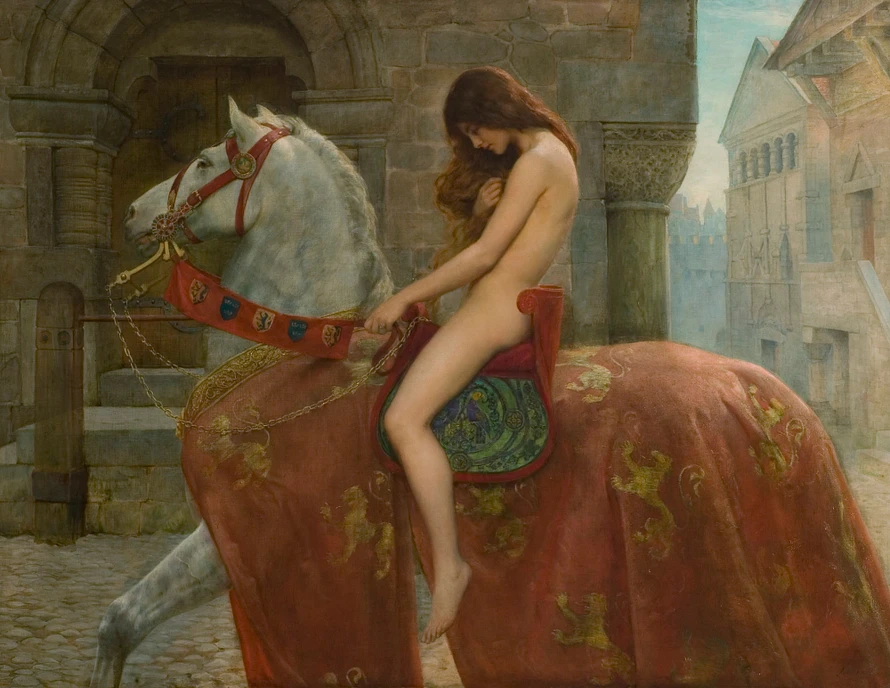
A solitary woman rides through an empty medieval street. Her head is bowed, her long hair falls around her body, and beneath her moves a magnificent white horse draped in crimson and gold.
It is an image of extraordinary beauty and vulnerability. Yet behind its apparent stillness lies a story of protest, power, sacrifice — and a curious question about the very act of looking.
John Collier’s Lady Godiva (1898) is among the most celebrated depictions of an English legend that has endured for nearly a thousand years. But the history behind the painting is more complicated, and more fascinating, than it first appears.
The Real Lady Godiva: History or Legend?
Lady Godiva was not simply a mythical character. Known in Anglo-Saxon England as Godgifu, she was a real eleventh-century noblewoman and the wife of Leofric, Earl of Mercia.
Godiva was a wealthy landowner and religious benefactor, associated with the foundation and support of churches and monasteries, including religious institutions in Coventry. Her historical existence is well established.
Her famous horseback ride, however, is another matter.
According to the legend, Godiva was deeply troubled by the heavy taxes imposed upon the people of Coventry. She repeatedly pleaded with her husband to relieve their suffering, until Leofric finally offered her an extraordinary bargain: he would grant her request if she rode naked through the town.
Determined to help the people, Godiva accepted.
The townspeople were said to have remained indoors, closing their windows and averting their eyes as she passed. Her long hair provided a measure of modesty, and her remarkable act of courage persuaded Leofric to honour his promise.
It is a powerful story — but there is no contemporary evidence that the ride actually happened. Written accounts emerged long after Godiva's lifetime, suggesting that the legend developed gradually around a genuine historical figure.
Peeping Tom: A Later Addition to the Story
Perhaps the most famous detail of the Godiva legend is the man who dared to look.
According to later versions, a townsman known as Peeping Tom secretly watched Godiva as she rode through Coventry, breaking the agreement that everyone would avert their eyes. For his transgression, he was supposedly struck blind.
But this familiar character was not part of the earliest recorded story. Peeping Tom appears in the tradition centuries later, in the seventeenth century.
His addition changed the meaning of the legend. What had begun as a story of generosity and resistance became something more: a tale about privacy, temptation, shame and the consequences of looking where one should not.
That theme would become particularly intriguing in the hands of Victorian artists.
John Collier’s Lady Godiva: Courage in Stillness
Painted in 1898, John Collier’s Lady Godiva belongs to the world of late-Victorian historical and romantic painting, with its rich detail, idealised beauty and affinity with Pre-Raphaelite art.
Yet Collier chooses a remarkably restrained moment.
There are no cheering crowds, no confrontation with Leofric, and no dramatic declaration of protest. Instead, Godiva moves quietly through an apparently deserted city.
Her head is lowered, her expression inward and her body almost motionless. She appears vulnerable, perhaps apprehensive, yet composed.
The horse provides a striking contrast.
Its raised head, alert ears and powerful form suggest energy and movement. The elaborate red-and-gold cloth covering its body adds richness and ceremony to the scene, almost transforming the animal into a participant in a solemn procession.
Behind them, pale medieval architecture stretches into the distance. The deserted street reinforces the silence of the legend: a whole city has withdrawn from sight to honour one woman’s extraordinary journey.
Collier transforms what might have been a sensational spectacle into something unexpectedly intimate.
The contrast between the strength of the horse and the quiet vulnerability of its rider is one of the painting’s most memorable qualities.
The Painting Nobody Was Supposed to Look At
There is a fascinating contradiction at the heart of Collier’s painting.
According to the legend, Godiva’s dignity was protected by the townspeople’s refusal to look at her. Yet the painting invites us to do precisely what they were forbidden to do.
We become spectators of a moment that was supposed to remain unseen.
Art historian Kate Nichols, writing about Collier’s Godiva for the University of Birmingham, has explored this tension between the painting, Victorian attitudes towards the nude and the responsibilities of the viewer.
The work was created at a time when the depiction of unclothed women in public galleries remained entangled with questions of artistic beauty, morality and social expectations.
There is also an intriguing human story behind the figure herself.
Research into the painting suggests that Collier’s model may have been Mabel Violet Hall, later known as Mab Paul, who became an actress on the Edwardian stage.
Preparatory studies reveal that Collier experimented with Godiva’s pose before settling on the familiar side profile. That artistic decision helped create the painting’s distinctive sense of inwardness and emotional distance.
Rather than confronting the viewer, Godiva appears absorbed in her own experience.
It is this ambiguity — between vulnerability and resolve, public spectacle and private emotion — that gives the painting much of its lasting power.
Why Lady Godiva Still Matters
Whether or not the legendary ride took place, its meaning has continued to evolve.
Godiva has become a symbol of compassion, resistance to injustice and the willingness to make a personal sacrifice for others. Her story has inspired poetry, painting, sculpture, music and centuries of local tradition in Coventry.
The legend enjoyed renewed popularity in the Victorian period, particularly following Alfred, Lord Tennyson’s poem Godiva, published in 1842.
For Victorian audiences, she could embody modesty and moral virtue. For modern viewers, her story may also raise questions about women's agency, political protest, bodily autonomy and the ways historical women are remembered.
Collier’s painting allows these interpretations to coexist.
What makes it so compelling is not simply the unusual nature of Godiva’s legendary protest, but the humanity of the moment he imagines: one figure alone, undertaking something extraordinary.
Where Can You See John Collier’s Lady Godiva?
The original oil painting belongs to the Herbert Art Gallery & Museum in Coventry, the city with which Godiva's legend is inseparably connected.
Measuring approximately 142 × 183 cm, it remains one of the Herbert’s most recognisable artworks and an important part of the city's cultural identity.
In 2024, the painting even travelled to the Palace of Versailles for an exhibition exploring the horse's place in European civilisation — a reminder of its significance beyond Coventry.
More than a century after Collier completed it, Lady Godiva continues to invite us to consider the relationship between beauty, courage, myth and history.
And perhaps its greatest achievement is that it makes a legendary act of defiance feel so profoundly human.
Explore Lady Godiva at Between Forms
Inspired by John Collier’s remarkable painting, our Lady Godiva collection brings this historic artwork into everyday spaces through carefully prepared adaptations for desk mats, mouse pads and phone cases.
Each design aims to retain the character, atmosphere and detail of the original painting while thoughtfully adapting it for its new format.