
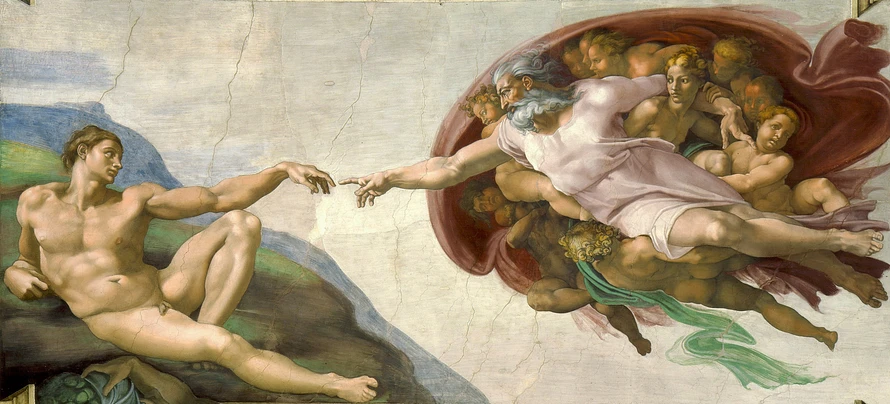
Few details in the history of art are more recognisable than the nearly touching hands in Michelangelo’s The Creation of Adam.
Even people who have never visited the Sistine Chapel usually know the image: God reaching forward with purpose, Adam answering with an outstretched hand, and their index fingers separated by the smallest sliver of empty space.
It has become one of the most reproduced fragments in Western art, appearing in films, advertising, cartoons, posters and countless parodies. Yet the extraordinary thing is how little is actually happening. There is no thunderbolt, no visible spark and no dramatic burst of divine light.
Michelangelo builds the entire moment around a gap.
That tiny interval between two fingers transforms a biblical story into something immediate and almost suspenseful: a moment suspended between stillness and action, human and divine, possibility and fulfilment.
Michelangelo and the Sistine Chapel Ceiling
The Creation of Adam forms part of Michelangelo’s vast fresco cycle on the ceiling of the Sistine Chapel in Vatican City.
Pope Julius II commissioned Michelangelo to redecorate the damaged ceiling in 1508. The original plan was considerably simpler, calling for twelve apostles accompanied by decorative elements. Michelangelo considered the scheme inadequate, and what followed became one of the most ambitious artistic projects of the Renaissance.
By the time the ceiling was completed in 1512, Michelangelo had filled it with hundreds of figures arranged within an immense painted architectural framework.
Although Michelangelo considered himself first and foremost a sculptor, the popular image of him as a man almost entirely unfamiliar with painting is misleading. As a young artist in Florence he had worked in the workshop of Domenico Ghirlandaio, where he learned techniques of drawing, painting and fresco.
The Sistine ceiling nevertheless gave him an opportunity to approach painting almost sculpturally. Bodies dominate the composition. They twist, stretch and occupy space with extraordinary physical presence.
At the centre of the ceiling are nine scenes from the Book of Genesis, moving from the creation of the universe through the creation and fall of humanity to the story of Noah.
Among them is The Creation of Adam.
One Scene, One Instant
Michelangelo could have depicted Adam being formed from the earth. Instead, he chose something far more dramatic.
Adam already exists.
He lies upon the ground as a fully formed young man, his body possessing the idealised muscular beauty that runs throughout Michelangelo’s art. But despite this physical perfection, something seems absent.
Adam is relaxed. His body appears heavy against the earth. His arm rises towards God, but without urgency, and his wrist and fingers remain loose.
The Vatican Museums describe him memorably as a “resting athlete”.
God, by contrast, arrives with tremendous energy.
Surrounded by a dense group of figures and wrapped within a billowing mantle, he appears to surge through space towards Adam. His body twists forward while his right arm extends decisively across the empty centre of the composition.
The contrast is striking.
Adam possesses form but little momentum. God is almost entirely movement.
Michelangelo turns the act of creation into a meeting between potential and energy.
Why Don’t Their Fingers Touch?
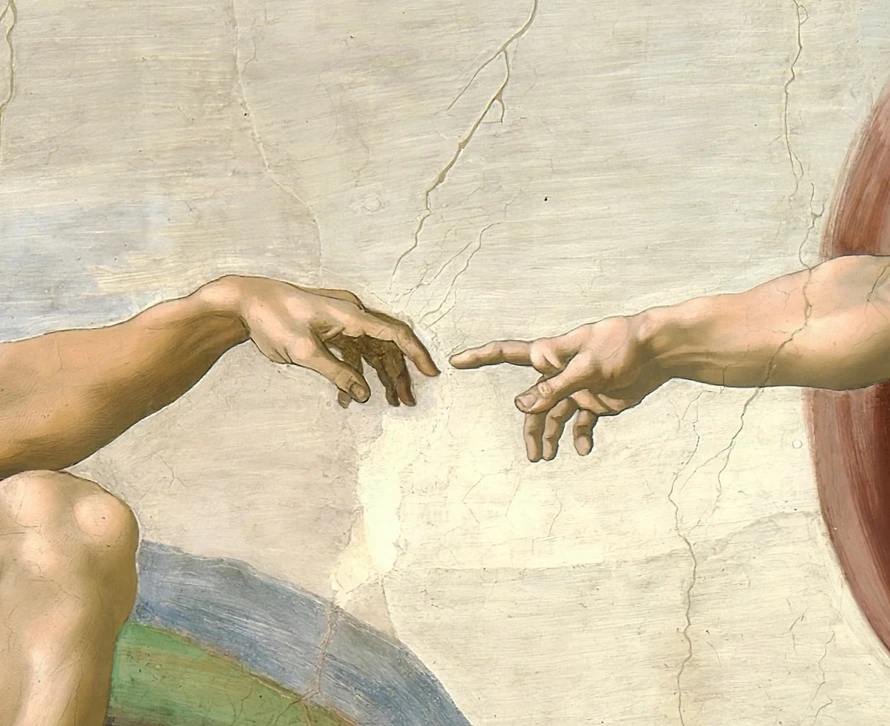
The most famous part of the fresco is also one of its simplest.
God’s index finger extends towards Adam’s.
Adam reaches back.
But they do not touch.
That small decision changes the entire picture.
Had Michelangelo joined the fingers, we would be looking at a completed action. Instead, he leaves the decisive moment permanently unfinished.
The eye moves naturally along God’s outstretched arm, across his hand and towards Adam — only to stop at the gap.
It creates anticipation.
The viewer mentally completes the movement that Michelangelo refuses to show.
There is no need for a painted flash of light or a visible bolt of divine energy. The empty space itself becomes charged.
It is easy to see why the gesture has acquired interpretations involving the “spark of life”, although that phrase should not be mistaken for a literal symbol Michelangelo painted into the fresco. The power comes precisely from what is missing.
The image remains eternally one fraction of a second away from completion.
Made in the Image of God
There is another important relationship between the two figures.
Adam and God echo one another.
The biblical passage associated with the scene is Genesis 1:26–27, in which humanity is created in the image and likeness of God. Michelangelo gives that idea a remarkably physical form.
God is not represented as an abstract beam of light or a distant supernatural force. He has an intensely human body: muscular, powerful and filled with movement.
Adam, too, is idealised.
Their extended arms establish a visual bridge between them, while their bodies create a loose correspondence across the composition.
The resemblance does not erase the difference between creator and creation. God is active where Adam is passive; God moves while Adam waits.
But Michelangelo makes the connection unmistakable.
The scene is about distance between the human and divine — and resemblance between them at the same time.
Who Are the Figures Around God?
God does not arrive alone.
He is surrounded by a tightly packed group of figures enclosed within the sweeping red mantle behind him. The Vatican Museums describe them broadly as angels, but the identity of individual figures has inspired centuries of interpretation.
Most noticeable is the figure immediately beneath God’s left arm.
With softer features and a distinctly different appearance from many of the surrounding figures, this character has often been identified as a woman. One influential interpretation sees her as Eve, waiting to be created after Adam and already existing in divine thought.
Other identities have also been proposed.
There is no surviving explanation from Michelangelo that settles the question, so claims that the figure is definitively Eve go beyond what can actually be proven.
The ambiguity may be part of the appeal.
Michelangelo makes the central action perfectly clear while allowing the surrounding group to remain mysterious.
Did Michelangelo Hide a Human Brain?
Perhaps the most famous modern theory surrounding The Creation of Adam is that the shape surrounding God resembles the anatomy of a human brain.
The idea is often repeated online as though it were a recognised secret deliberately hidden by Michelangelo.
The real story is more complicated — and more interesting.
In 1990, physician Frank Lynn Meshberger published an article in the medical journal JAMA arguing that the red mantle and the arrangement of figures around God correspond to structures visible in a section through the human brain.
Meshberger suggested that Michelangelo may have been linking God’s gift to Adam with human intellect.
There is one important reason the theory cannot simply be dismissed as impossible: Michelangelo really did possess an exceptional knowledge of anatomy.
Like several Renaissance artists, he studied human bodies directly, including through dissection. His understanding of muscles, skeletons and the mechanics of the body is visible throughout his work.
But anatomical knowledge is not proof of a hidden anatomical diagram.
No document from Michelangelo explains the mantle as a brain, and the interpretation appeared almost five centuries after the ceiling was painted.
The distinction is important:
Michelangelo’s knowledge of anatomy is established fact.
The hidden brain is a theory.
It is an intriguing theory, and the visual similarities are striking enough to ensure that it continues to be discussed. But it should not be presented as a solved Renaissance code.
A Brain, a Womb — or Neither?
The need for caution becomes even clearer when we look at other anatomical interpretations.
Some researchers have argued that the same surrounding shape can instead be read as reproductive anatomy, including the form of a uterus, turning the scene into a visual metaphor for birth.
Other writers have proposed still more concealed organs and anatomical structures elsewhere in Michelangelo’s work.
The problem is obvious: once viewers begin searching a complex arrangement of bodies and drapery for anatomical forms, multiple patterns can emerge.
That does not prove Michelangelo intended none of them.
Nor does it prove that he intended any particular one.
The anatomical theories are therefore best treated as fascinating later interpretations rather than hidden meanings known with certainty.
And perhaps they tell us something else about Michelangelo’s achievement: five centuries later, people are still looking closely enough at the fresco to discover new possibilities within it.
Michelangelo in Colour
Modern viewers can easily forget that the Sistine Chapel ceiling did not always look the way it does today.
For centuries, Michelangelo’s frescoes accumulated dirt, dust, smoke and the effects of earlier attempts at conservation. The result was a ceiling that appeared much darker and more subdued than the one Michelangelo had painted.
A major restoration campaign beginning in the late twentieth century removed much of this accumulated material.
The results were startling.
Beneath the darkened surface appeared brilliant greens, blues, pinks, oranges and other unexpectedly vivid colours.
The restoration changed the popular image of Michelangelo.
He had often been imagined primarily as a sculptor who happened to paint — an artist concerned above all with massive bodies, modelling and line. The cleaned ceiling revealed just how important colour was to his design.
The restoration was not without controversy, particularly over whether cleaning might have removed some original finishing work, but it transformed modern understanding of the ceiling and returned much of its extraordinary visual intensity.
The Michelangelo familiar from old reproductions was considerably darker than the Michelangelo now visible in the Sistine Chapel.
How Two Hands Escaped the Sistine Chapel
The Sistine Chapel ceiling contains hundreds of figures and some of the most complex imagery in Western art.
Yet two hands have escaped from it.
The gesture between God and Adam has become an image in its own right, detached from the rest of the ceiling and recognisable even when almost everything else is removed.
That is unusual.
Many great paintings depend upon their complete composition. The Creation of Adam can survive extreme cropping.
Show only the arms and hands and the image remains identifiable.
Replace one hand with an object and viewers still understand the reference.
Reverse the context entirely and the original composition remains somewhere in the background of our visual memory.
Researchers studying visual communication have used The Creation of Adam as an example of an image that has entered a kind of shared “visual lexicon”: a composition so familiar that it can be altered, parodied or recombined while remaining recognisable.
Advertising has used it.
Cartoonists have used it.
Films, television programmes, album artwork and internet memes have used it.
The reason is not simply that the fresco is famous.
Its structure is unusually adaptable.
Two opposing forms.
Two extended arms.
A gap.
And the expectation that something is about to happen.
Michelangelo could hardly have designed a more reusable visual formula if he had intended to.
Why The Creation of Adam Still Resonates
More than five centuries after Michelangelo painted it, The Creation of Adam still feels remarkably immediate.
Its religious meaning belongs to the enormous theological programme of the Sistine Chapel, but its visual power extends beyond that context.
It is an image about creation, but also about connection.
About potential.
About the instant before something changes.
Michelangelo takes one of the largest imaginable subjects — the creation of humanity — and concentrates it into one of the smallest imaginable spaces.
The decisive part of the picture is not God.
It is not Adam.
It is not even their hands.
It is the gap between them.
And more than 500 years later, those fingers are still about to touch.