
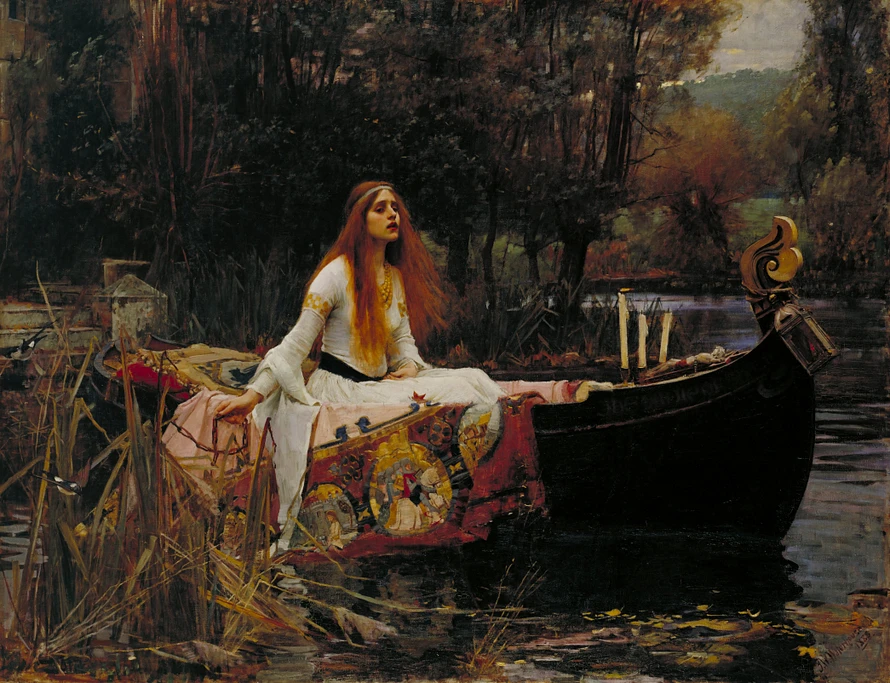
John William Waterhouse’s The Lady of Shalott looks quiet at first.
A young woman sits alone in a small boat. The river is still. Autumn vegetation crowds the banks. A tapestry spills over the side. Nothing appears to be happening very quickly.
But this is not a peaceful journey.
Waterhouse has chosen one of the most tragic moments in Alfred, Lord Tennyson’s poem The Lady of Shalott: the instant when the Lady releases her mooring and begins the journey that she already knows will end in death.
The painting is not really about where she is going.
It is about the moment when there is no going back.
The woman who could only see the world in a mirror
Tennyson first published The Lady of Shalott in 1832 and substantially revised it in 1842. His story draws on Arthurian legend and an earlier medieval Italian tale, but adds a strange and memorable curse.
The Lady lives alone in a tower on an island near Camelot.
She has been warned that a curse will fall upon her if she looks directly towards the outside world. Instead, she watches life indirectly through a mirror and weaves the reflected images into a tapestry.
People travel along the road. Lovers meet. Knights ride past. Life continues outside her walls while she remains separated from it.
Eventually she admits that she is tired of experiencing the world only through reflections.
Then Sir Lancelot appears.
When she sees him in the mirror, she turns away from her loom and looks directly out of the window. The mirror cracks. Her weaving breaks loose.
The curse has begun.
Waterhouse does not paint the dramatic moment you might expect
Many artists could have chosen the instant when the mirror shatters or the Lady first sees Lancelot.
Waterhouse chose something quieter.
His 1888 painting shows what happens afterwards.
The Lady has left the tower. She has found a boat, written her name upon it and is preparing to drift downstream towards Camelot. Waterhouse shows her right hand releasing the chain that holds the boat to the bank. Her lips are slightly parted as she begins the final song described by Tennyson.
It is a remarkably restrained way of showing catastrophe.
Nothing explodes. Nobody struggles.
The tragedy is already decided.
Look at the chain
One of the smallest details in the painting is also one of the most important.
The Lady’s hand is letting go of the chain.
Once she releases it, the river takes control.
Waterhouse turns that simple gesture into the psychological centre of the painting. She is not being dragged into the boat. She is not unconscious of what is happening.
She actively lets go.
That does not mean she has escaped the curse. Quite the opposite. But it gives the scene a strange mixture of helplessness and agency: fate has closed around her, yet she still chooses to leave the tower and move towards the world she has been forbidden to experience.
That tension is part of what makes the painting so much more affecting than a straightforward illustration of the poem.
The tapestry comes with her
Draped over the side of the boat is the fabric the Lady spent her life weaving.
It is an extraordinary detail because the tapestry belonged to her old existence.
In the tower, she did not participate directly in life. She watched reflections of other people and converted those images into art. Now, as she finally enters the real world, the tapestry trails behind her and almost into the river.
Tate identifies it specifically as the fabric she wove while confined near Camelot.
It is difficult not to see a symbolic meaning in that transition.
The Lady has spent her life creating images of a world she could not touch. The moment she chooses reality over representation, both her artwork and her protected existence begin to unravel.
That is one reason the poem has often been read as a story about the artist: someone separated from ordinary life, transforming experience into images while observing it from a distance.
That interpretation is not the only way to read the poem, but it has been an enduring one.
Three candles — but only one still burns
At the front of the boat sits another quiet warning.
There are three candles.
Two have already gone out.
Only one remains burning.
Tate notes that candles were often associated with life and interprets the extinguished pair as an indication that the Lady’s life is nearing its end. Beside them lies a small crucifix, reinforcing the funereal atmosphere of the journey.
Waterhouse does not need to show the Lady dying.
He has placed death all around her in objects.
The extinguished flames tell us what the Lady herself already seems to understand.
Why the painting feels so still
Waterhouse’s composition is full of details, yet the scene has an extraordinary sense of suspension.
The Lady’s white dress makes her immediately visible against the darker riverbank and dense vegetation. She appears almost luminous within an environment already beginning to close around her.
There is movement — the water, the trailing tapestry, the boat preparing to drift — but the painting seems to hold everything for a fraction of a second.
That stillness is part of the tension.
We are looking at the final pause before the current carries her away.
Waterhouse and the Pre-Raphaelite world
The Lady of Shalott is often grouped with Pre-Raphaelite art, though Waterhouse himself was not one of the original Pre-Raphaelite Brotherhood. He was born in 1849, the year after the Brotherhood was founded.
He belonged to a later generation, but increasingly adopted subjects, colours and literary interests associated with the movement.
Literature, mythology, symbolism, medieval settings and idealised female figures all became central to his mature work.
Tennyson was a particularly rich source for artists working in this tradition.
His poems offered exactly the kind of material they loved: doomed love, psychological tension, beautiful landscapes and stories poised somewhere between reality and legend.
The Lady of Shalott became one of the most frequently imagined of them all.
Was Waterhouse painting a real woman and a real landscape?
Although the story belongs to Arthurian legend, Waterhouse appears to have grounded the painting in the world around him.
The model has traditionally been identified, though not with absolute certainty, as Waterhouse’s wife, Esther Kenworthy Waterhouse. Tate also notes that the landscape may have been inspired by Somerset or Devon, areas the couple frequently visited. Tate Online Shop
That does not make the painting a literal portrait or an identifiable stretch of river.
But it may help explain why the fantasy feels so tangible.
The reeds, muddy water, autumn vegetation and heavy woodland are not vague medieval scenery. They have the specificity of an observed landscape.
Waterhouse anchors Tennyson’s supernatural story in something recognisably physical.
The curse may be unreal.
The cold river does not feel unreal at all.
Waterhouse painted the story three times — in reverse
Waterhouse returned to the Lady of Shalott across nearly three decades.
The famous 1888 painting shows the end of the story: the Lady has already broken the curse, left the tower and begun her fatal journey towards Camelot.
In 1894, Waterhouse went backwards.
The Lady of Shalott Looking at Lancelot, now in Leeds Art Gallery, shows the earlier instant when she abandons the loom and turns to look directly towards Lancelot — the decision that activates the curse. Wikipedia
Then, in 1915, he went backwards again.
“I Am Half-Sick of Shadows,” Said the Lady of Shalott, now in the Art Gallery of Ontario, shows her still inside the tower before Lancelot appears, already weary of experiencing life only through reflections. art.ago.ca
So the paintings were created in the opposite order to the events they depict:
1915 — confinement and dissatisfaction
1894 — the forbidden look
1888 — the fatal journey
Seen together, they form something like a psychological trilogy.
Waterhouse first painted the consequence, then the moment of transgression, and finally the dissatisfaction that made the transgression almost inevitable.
That makes the 1888 painting especially interesting.
The curse has already been triggered.
Death has not yet arrived.
The Lady sits between the two.
What happens after the scene in the painting?
The river carries her towards Camelot as she sings.
She never arrives alive.
Tennyson describes her voice gradually fading as the boat travels downstream. By the time it reaches Camelot, the Lady is dead.
The inhabitants come out to look at the mysterious woman whose name is written upon the boat.
And then Lancelot — the man whose appearance caused her to turn towards the forbidden world — sees her.
His response is chilling partly because it is so limited.
He admires her face and asks God to grant her grace.
He does not know what she has sacrificed.
He does not even know her story.
A painting about the point of no return
That knowledge changes the way Waterhouse’s painting feels.
The Lady is not simply a beautiful woman sitting in a picturesque boat.
The chain in her hand matters.
The tapestry matters.
The extinguished candles matter.
Even the calmness matters.
Waterhouse shows a person who has crossed an invisible boundary. For most of her life, the Lady could observe the world but never enter it. When she finally chooses direct experience, the price is fatal.
And perhaps that is why the painting has lasted so well.
Its world belongs to Victorian poetry and Arthurian legend, but the conflict at its centre is much more familiar: the tension between safety and experience, watching and participating, isolation and connection.
The Lady chooses the world outside her tower.
For one brief journey, it finally becomes real.
Artwork: John William Waterhouse, The Lady of Shalott, 1888. Oil on canvas, approximately 153 × 200 cm. Tate Britain, London; presented by Sir Henry Tate in 1894.
Bring Waterhouse’s world into everyday life
Explore The Lady of Shalott and other works by John William Waterhouse across the Between Forms collection.
Explore the Waterhouse collection at Between Forms